Guide Wolf Range Hood Repair
Yellow Flames When the Oven Fires: Manometer-Testing Gas Supply to a Wolf Range in Denver's Pre-War and Postwar Kitchens
Wolf burners that yellow-tip when the oven fires are usually starved of gas rather than faulty. Wolf specifies a 3/4-inch ID supply line, 5 inches water column supply pressure and 7 inches WC minimum line pressure; a manometer at the inlet under load settles it.
Written by Denver
Carys Pemberton
Cooking-appliance technician — burners and gas pressure · 20 years in the trade
Puts a manometer on the manifold before pulling a range out of its run. Yellow flames and soot are usually a supply or an orifice question, and both are answered from the front.
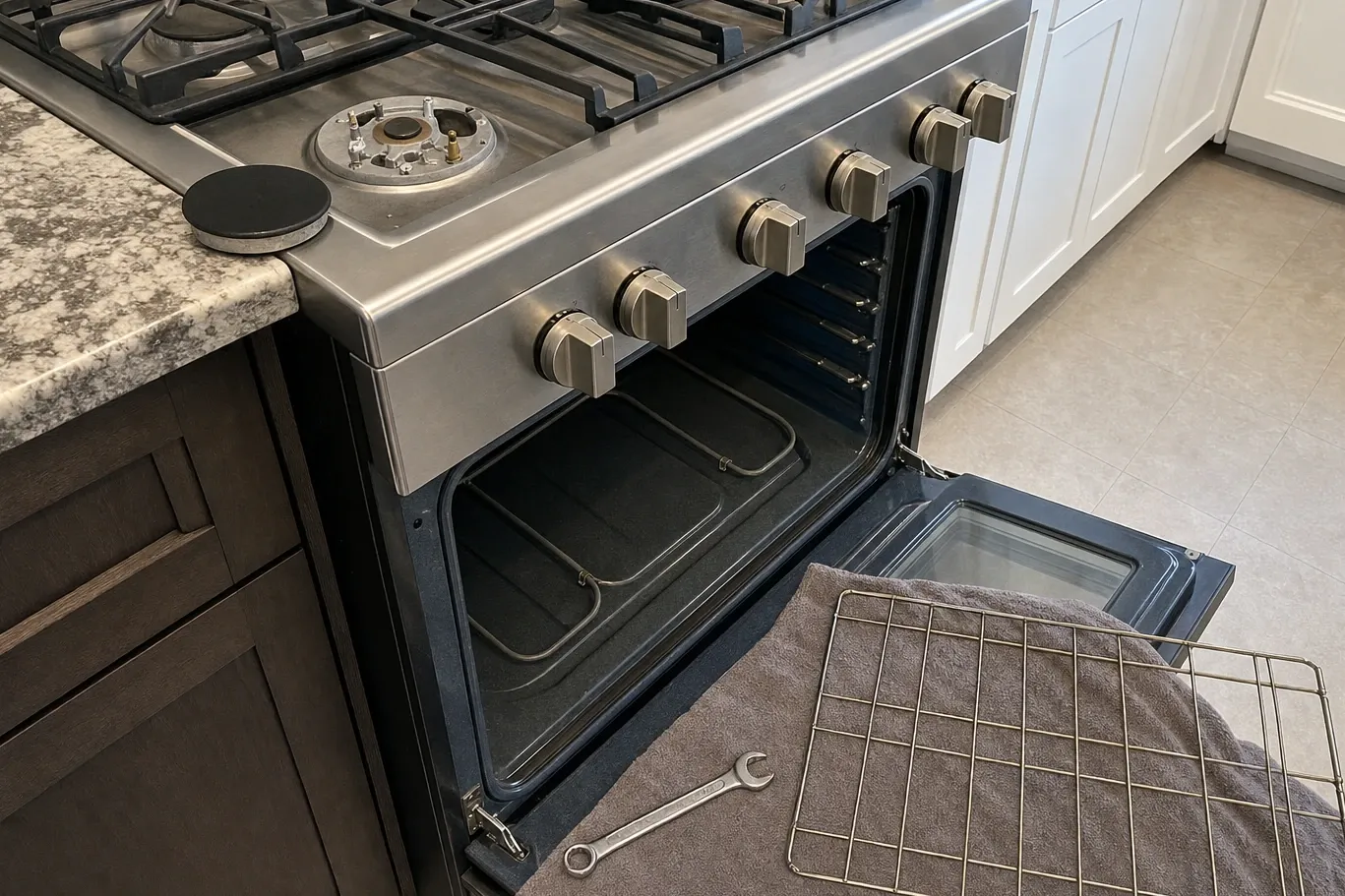
A Wolf range that behaves perfectly with two burners lit and turns yellow and lazy the moment the oven joins in is not usually telling you about its igniters. It is telling you about the pipe behind the wall — and in Denver’s streetcar-era and postwar kitchens, that pipe was sized for a different century’s cooking.
The question worth asking first
Ask what the gas supply measures under load, before asking which part failed. Wolf publishes the numbers to test against: a 3/4-inch inside-diameter supply line is to be provided to the appliance, natural gas supply pressure is specified at 5 inches water column, minimum line pressure at 7 inches WC, and maximum regulator pressure at 14 inches WC, which is half a psi.
Those figures turn a vague complaint into a pass or fail. Without them, “the flames look wrong” is an opinion, and opinions get resolved by replacing parts. With them, one instrument settles the argument in ten minutes and either exonerates the piping or condemns it.
What shortens an appliance life here specifically
The housing stock is the story. Platt Park developed from the 1890s through the 1920s. Park Hill’s record runs from about 1893 through the 1907-to-1917 and 1920-to-1930 building booms. University Hills is a ranch tract begun in 1951. Cheesman Park mixes historic mansions with 1960s condo buildings working off masonry shafts and shared risers. Every one of those kitchens was piped for a small domestic range.
A pro-style burner array is a high-input device, and it is unforgiving of a supply that cannot keep up. The failure is not a rupture; it is a sag. An old half-inch iron run pressed into service, a long branch with a lot of fittings, or a meter and regulator sized for a mid-century load will hold pressure comfortably at idle and lose it the instant the total demand rises. Because the shortfall only appears under load, the appliance seems intermittent, and intermittent faults are the ones that get misdiagnosed most expensively.
There is a second, slower cost. Sustained incomplete combustion sooties pans, dirties burner ports, and loads the ventilation with residue that a hood then has to move — so a starved supply quietly generates cleaning and hood work that would not otherwise exist.
Reading the machine you already own
The symptoms are specific and repeatable, which is what makes them useful. Burners that light cleanly one at a time but go lazy or yellow-tip when the oven ignites. Delayed ignition with a soft thump. An oven that cannot hold or recover its setpoint during preheat while the cooktop is working. A griddle section that never quite reaches temperature when the rest of the range is busy.
Test it yourself the crude way before anyone brings a tool: light one burner and watch the flame, then bring the others up one at a time, then fire the oven, and watch whether the original flame changes character. A flame that was blue and tight at the start and goes soft, tall or orange-tipped as demand rises is describing the supply, not itself. A flame that is wrong from the first second with nothing else running is describing the burner — a blocked port, a misseated cap, a wrong orifice — and that is a different repair entirely.
Note also whether the house has other gas loads that come on by themselves. A furnace or water heater firing mid-cook adds demand the cook did not schedule, which is why the fault often seems worse in winter.
Repair, or start again
Nothing inside the range fixes a starved supply, and this is the crux. A manometer reading at the appliance inlet, taken at rest and again under full load and compared against Wolf’s published 5-inch WC supply and 7-inch WC minimum line pressure, decides which side of the wall the money should go. If pressure holds and the fault persists, the appliance is genuinely at fault and the parts are worth buying. If it sags, the correct work is upstream: resizing the branch, correcting the run, or addressing the meter and regulator — a licensed gas trade’s job with a permit, not a parts swap.
Owners occasionally conclude that the range is simply too much for the house and should go. It rarely needs to. The appliance is usually fine; the delivery is not, and the delivery is repairable.
What a diagnosis gives you
An $89 diagnostic visit produces a measurement and a verdict rather than a shortlist. If the supply passes, the follow-on work is priced as follows: an igniter or spark module runs $170 to $470, burner valve or orifice service $240 to $630, oven thermostat or sensor calibration $210 to $450, a convection fan or motor $270 to $650, a control board or touch panel $470 to $850, and door hinge, glass or seal work $300 to $740.
If the supply fails, you get something more valuable than a repair: the reason your last two repairs did not hold, in a form a gas fitter can act on. A call to (720) 702-9054 settles in five minutes what a form cannot. That sequence is the diagnosis, half done, before anyone arrives.
Follow-ups
- Can I test my own gas pressure with a manometer?
- Better not. Reaching the appliance inlet tap means breaking a gas connection, and putting it back properly is licensed work with a leak test afterwards. The useful homeowner version is observational: light the burners one at a time, then fire the oven, and watch whether an already established flame changes character as the demand climbs.
- Why is the problem worse in winter in my University Hills kitchen?
- Because the house is adding demand you did not schedule. A furnace and a water heater firing while the range is working raise the total draw on the same branch, and a supply that was marginal at idle sags further. If the yellow-flame behaviour tracks the heating season, that points hard at pipe capacity rather than at parts.
- The range worked perfectly in our last house. Why not in this one?
- Appliances move; piping stays put. A pro-style range that had an adequately sized run in a previous kitchen may now sit on an old half-inch branch with a long route and several fittings. Nothing about the appliance has changed and nothing inside it needs replacing. What it needs is its supply measured against the published requirements.