Guide Wolf Range Repair
Wolf burner clicks and will not light: what it is at 5,280 feet
A Wolf burner that clicks without catching, or keeps clicking after the flame is up, is almost never the cooktop. What the spark system is telling you, what to check in a Denver kitchen, and when it needs a meter.
Written by Denver
Carys Pemberton
Cooking-appliance technician — burners and gas pressure · 20 years in the trade
Puts a manometer on the manifold before pulling a range out of its run. Yellow flames and soot are usually a supply or an orifice question, and both are answered from the front.
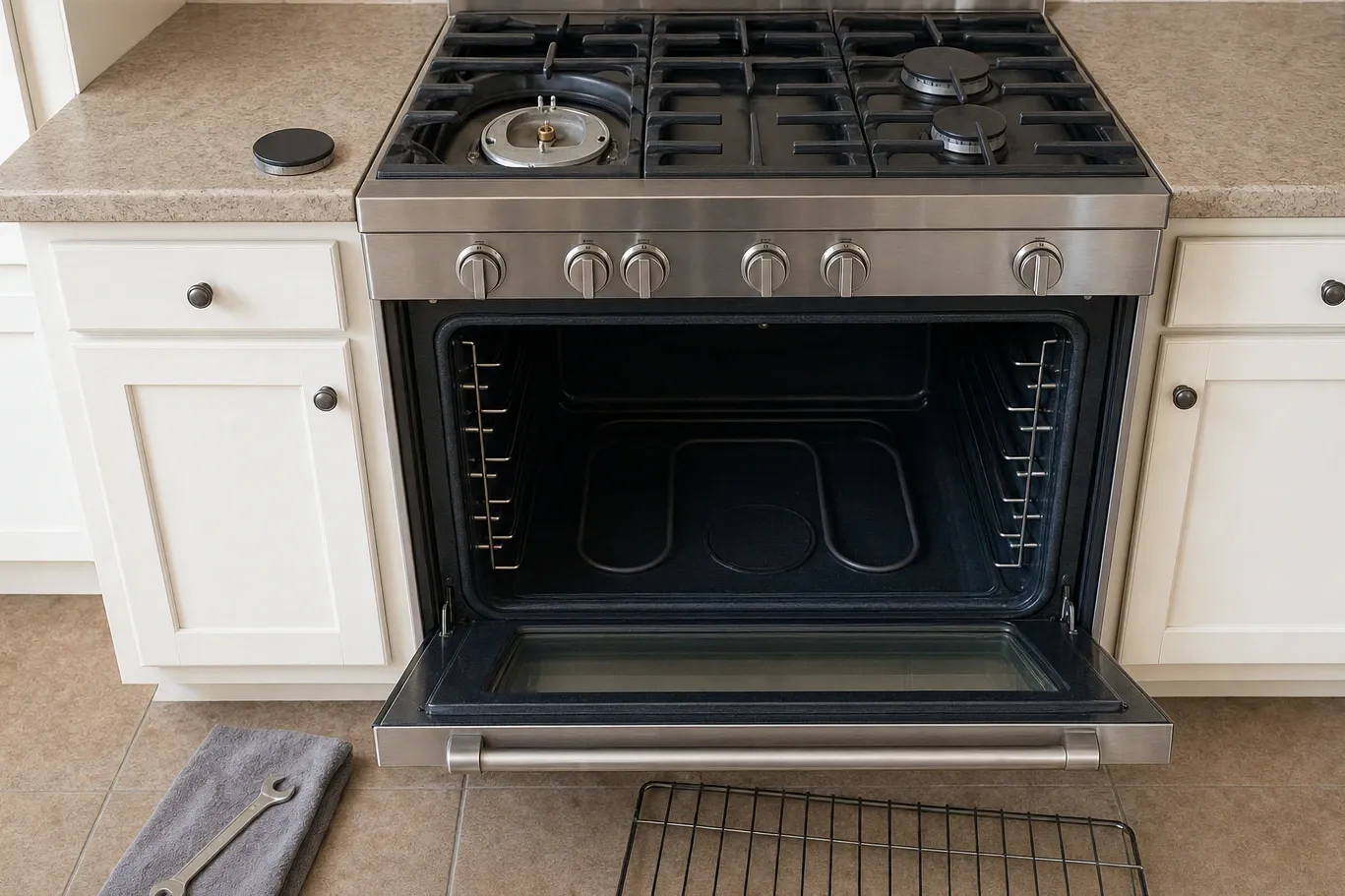
A Wolf cooktop clicks for a reason, and the reason is nearly always small. The sound is a spark module firing an electrode next to the burner head, waiting to see gas catch. When you hear clicking without a flame, or clicking that carries on long after the flame is up, the module is being told something that is not true — and finding out what usually takes a meter rather than a new appliance.
What the clicking is actually doing
Turn a Wolf burner knob and two things happen at once. A valve lets gas to the burner head, and a switch under the knob closes, which is the module’s cue to start firing. Its high-voltage pulses run out to the electrode standing a few millimetres from the burner ports, and each spark crosses to the burner itself, which is the earth path. Gas catches, the module stops, and everything goes quiet.
Every one of those steps can fail on its own, which is why the pattern matters more than the noise:
- One burner clicks, never lights. That burner’s electrode, its gap, or its gas path. Look at where the spark is going — if it is jumping to the pan support instead of the burner head, it will never light the gas.
- One burner lights, then keeps clicking. The switch under that knob has stuck closed. Old boil-over sets like glue in there.
- Every burner clicks at once, none light. The module, its earth, or the supply to it. This is the one that follows a power cut.
- Clicking only when it is cold, or only when it is damp. Moisture tracking across a cracked ceramic electrode insulator. It dries out, it works, you forget about it, and next month it is worse.
What to check before anyone comes out
Nothing here needs tools, and none of it means taking a panel off.
Take the grates and the burner caps off and look at the ports — the little slots around the rim of the burner head. If they are crusted, the flame cannot carry round to where the spark is. A soft brush and a straightened paper clip clear them. Do not use a drill bit or a needle file: an enlarged port changes the burner’s output, and at this elevation that matters more than it would in Kansas.
Look at the electrode. It is a small white ceramic pin beside one edge of the burner. If the ceramic is cracked, chipped or dark with tracking marks, that is your fault. If it is wet — and after a boil-over it often is — dry it, leave the burner for an hour and try again.
Check the cap is seated. A cap sitting proud by a millimetre puts the flame somewhere the spark cannot reach. It sounds too simple to be a real cause. It is a real cause.
Finally, listen once at the wall. If every burner clicks and nothing lights, switch off at the breaker for a full minute, then back on. A module holding a fault from a brownout will sometimes clear. If it comes straight back, stop there.
When it needs a meter, and why
Everything past that point involves live mains voltage inside a fixed appliance, and the spark module runs at several thousand volts on the output side. This is where a service call earns its keep.
On the visit, each switch gets tested under load rather than by feel — a switch can look and click perfectly and still be passing current when it should not. The module’s supply and earth get checked at the terminals. Electrode resistance and gap get measured against specification, and the whole manifold gets watched through a cold start, because a fault that only shows up at 6 a.m. in a 70-degree kitchen has to be reproduced to be believed.
Then, and this is the Denver part, orifice size and air shutter get checked against the burner rating. Thin air means a burner jetted for sea level runs rich here. Rich burners light late, burn yellow at the tips and put soot on the bottom of your pans — which is a mixture problem, not an ignition problem, and replacing a perfectly good electrode will not touch it.
The parts that actually fail
Commonest to rarest, the order runs like this: the switch under the knob, the electrode, the spark module, and the earth strap. Valves seize occasionally — usually presenting as a knob that will not hold a low flame rather than as a no-light. Wiring harnesses fail last, and almost always where grease and heat meet at the back of the manifold.
What is nearly never the answer: the whole cooktop, the control board on a dual-fuel model, or the gas supply. If someone has quoted you a control board for a clicking burner, ask them which measurement told them that.
What it means for the rest of the range
On a dual-fuel Wolf the top and the oven are two separate systems sharing a fascia. A clicking cooktop tells you nothing about the oven, and a dead oven tells you nothing about the top. That is worth knowing before you agree to anything described as a range repair — the fault is on one side or the other, and the visit should say which.
If the burner has been clicking for weeks, get it looked at rather than living with it. Constant sparking wears electrodes down and, on a burner that lights late, the little puff you hear on ignition is unburnt gas that has had time to collect. It is a cheap fault while it is still just a noise.
Follow-ups
- Is it safe to keep using a burner that clicks before it lights?
- For a second or two on a cold morning, yes — that is the spark system doing its job. What is not fine is gas flowing with no flame for more than about four seconds, or clicking that carries on after the burner is lit. Both mean unburnt gas or a stuck circuit, so shut that burner off and leave it off until it has been looked at.
- Why does only one burner do it?
- Because each burner has its own electrode, its own switch and its own orifice, even though they share one spark module. A single burner misbehaving points at that burner's own parts. Every burner clicking at once points at the module, the ground or the supply.
- Can a power cut cause this?
- It can. The spark module is mains powered, and a Denver summer storm that drops the supply for a moment can leave the module confused or, occasionally, damaged. If the clicking started the day after an outage, say so when you call — it changes what we bring.
- Does altitude cause clicking?
- Not directly. Altitude changes the air-to-gas mixture, which affects how a lit flame behaves — lazy yellow tips, poor simmer, soot. Ignition failure is electrical and mechanical. The two do get confused, because a burner jetted for sea level can light late and burn badly enough to look like an ignition fault.